Back To A Guide to Digital Marketing for Manufacturers
How to Reduce Cost Per Lead for Manufacturers
Many manufacturers face a digital marketing problem that most B2C brands never have to think about.
For manufacturers, there’s no instant return – it’s long sales cycles, technical buyers, and lead volumes that are naturally lower than consumer markets. That combination makes cost per lead (CPL) creep up quickly if campaigns aren’t tightly managed and the traffic isn’t qualified.
When every enquiry has the potential to become a high-value project or a multi-year supply contract, an inflated CPL doesn’t just hurt marketing budgets, it slows down the entire sales pipeline.
This matters because manufacturing marketing budgets are typically tighter and more scrutinised than in other sectors. Finance directors want to see a clear return, and sales teams want leads that convert, not just form-fills. If your lead generation for manufacturing strategy is generating expensive, low-quality enquiries, it undermines confidence in your digital marketing as a whole.
In this article, we’ll point you in the direction of what might be driving up your cost per lead and what practical ways to improve performance you can utilise to bring it down, and how we, as a specialist manufacturing marketing agency might approach this problem differently. By the end, you’ll have a step-by-step framework you can apply immediately, plus checklists and common mistakes to avoid.

TLDR – Top Tips
Cost per lead (CPL) measures the cost of generating a new enquiry. For manufacturers, improving CPL is rarely about reducing spend; it’s about making sure you’re investing your budget more effectively to generate higher-quality leads, improve conversion rates and demonstrate value across the business.
Key takeaways:
- Targeting precision beats budget size. Narrowing your campaigns to genuine buyer personas (procurement managers, engineers, plant operators) cuts wasted spend fast, meaning you’re not having to look for extra budget.
- Content and SEO help build a stronger organic pipeline over time, so you’re not relying solely on paid media to generate leads. As organic visibility grows, blended CPL can start to reduce too.
- Sales and marketing alignment ensures budget isn’t spent chasing leads that were never going to convert, which is one of the biggest hidden costs in manufacturing lead generation.
Why Manufacturing Lead Generation Is Different
Manufacturing buyers tend to research extensively before making contact and obtaining quotes. Purchases often involve multiple stakeholders too- each with different concerns. A generic PPC campaign built may get you seen, but it wont reach your desired audience effectively and will get lost in the noise.
This is why we recommend that lead generation for manufacturing needs sector-specific messaging. Campaigns should include technical specifications, compliance credentials, case studies with measurable outcomes, and proof of reliability. A campaign that overlooks this difference will generate clicks, but not qualified leads, driving CPL up even if the click cost looks cheap on paper.
Example: A precision components manufacturer running broad “engineering services” keywords might pay less per click than one targeting “CNC machining tolerances for aerospace,” but the second, more specific term converts at a far higher rate, ultimately delivering a lower cost per lead.

Key tactics for Reducing Cost Per Lead
1. Tighten Audience Targeting
Manufacturers often cast too wide a net targeting job titles or industries that sound relevant but rarely convert. Depending on your ad platform, we’d recommend using LinkedIn’s firmographic targeting, Google’s in-market audiences, and CRM data on your best existing customers to build a tighter profile.
2. Invest in long term visibility
Paid media delivers leads while you’re paying for it; SEO keeps delivering leads long after the initial investment. Manufacturers with strong technical content – spec sheets, application guides, comparison pages can build organic visibility that steadily reduces blended CPL. Our team’s work on the Google Manufacturer Centre shows how structured product data can also improve visibility and consistency across Google, indirectly supporting lower-cost lead generation.
3. Improve Landing Page Relevance
A lead form that mirrors the exact search intent, rather than a generic “contact us” tends to convert more visitors into leads. We’d suggest matching landing page headlines and copy to the ad or keyword that brought the visitor there.
4.Focus Sales team Time Where It Matters Most
Remember, not every enquiry is going to be at the same stage of the buying journey. By working with your sales team to qualify leads based on profile and behaviour, sales can spend more time with high-intent prospects, while marketing can better understand which activity is driving real business growth.
Building a Lower-CPL Lead Generation Strategy
1. Understand where your leads are coming from
Review performance across your key marketing channels to understand which activities are delivering the strongest return, and where there may be opportunities to improve efficiency.
2.Be tactical in who you’re trying to reach
The more clearly you define your ideal customer, the easier it becomes to focus your marketing on the businesses most likely to convert.
3.Be sure to refine your targeting
Regularly review your audience targeting to ensure your campaigns are reaching the right people at the right time, while minimising wasted spend.
4.Support the whole buying journey
Different prospects need different information. Creating content that answers questions at each stage of the decision-making process helps generate demand and reduces reliance on paid media alone.
5.Make the quality the priority over volume
Not every enquiry has the same value. Understanding which leads are the best fit for your business helps you focus your time and investment where it will have the greatest impact.
6.Review, learn and optimise
The most effective lead generation strategies are those who don’t stay the same. Regular reviews help identify what’s working, where budgets can be refined, and where new opportunities exist.
Helpful Resources and Common Pitfalls
Useful tools: GA4 for channel-level CPL tracking, HubSpot or a similar CRM for lead scoring, SEMrush or Ahrefs for keyword and content gap analysis.
Simple CPL checklist:
- Is spend tracked by channel and campaign, not just in total?
- Are landing pages tailored to specific search intent?
- Is there a lead scoring model in place?
- Are sales and marketing reviewing lead quality together monthly?
Common mistakes:
- Treating every enquiry as equally valuable, regardless of fit.
- Running the same generic messaging across all industries served.
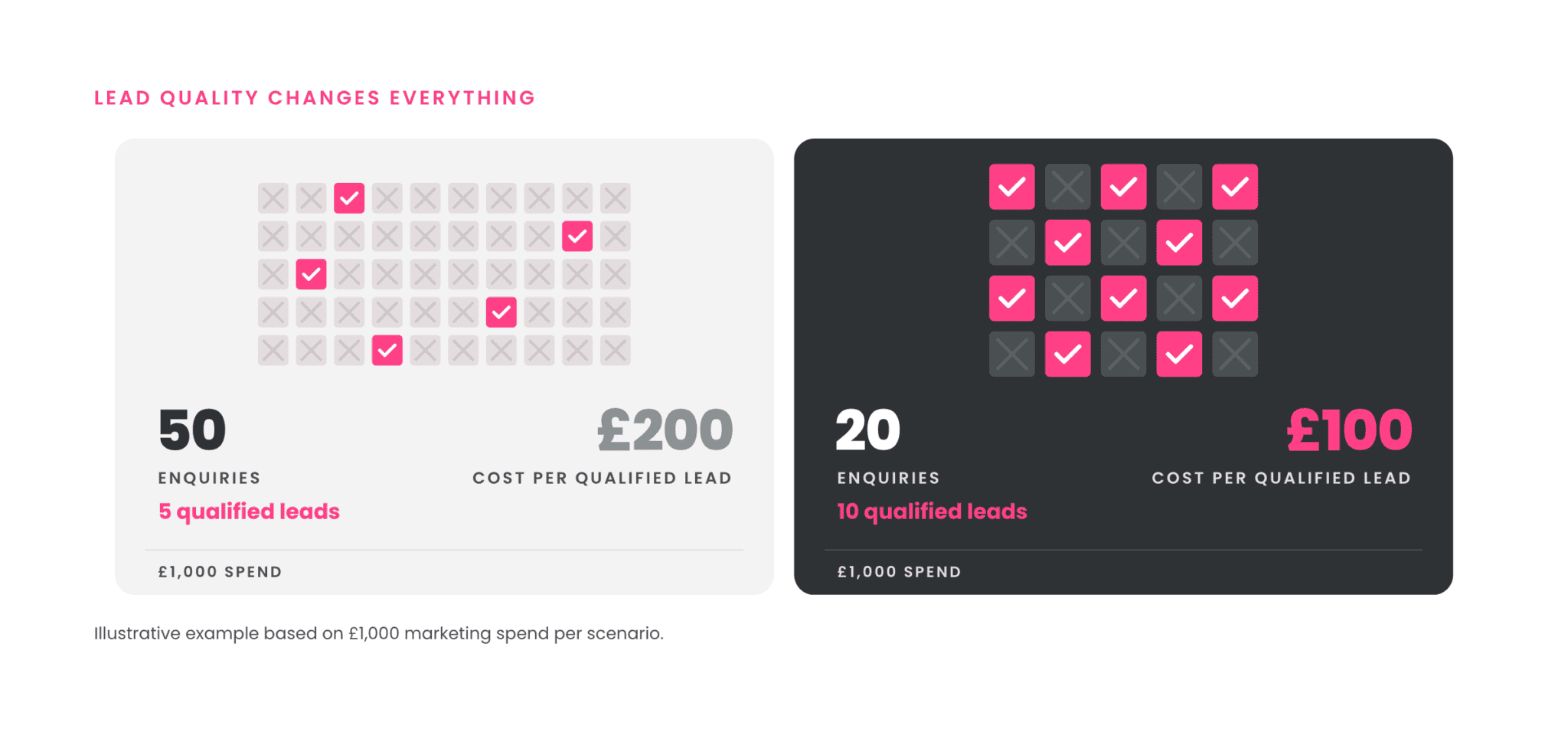
- Measuring success by lead volume rather than lead quality or cost per qualified lead.
- Relying on paid media to generate every lead, instead of building long-term visibility through SEO, content and AI-driven discovery.
Manufacturers who get this right typically see CPL fall over a two-to-three-month period as targeting sharpens and organic content begins to contribute leads without ongoing ad spend.
How Peaky Digital Approaches Manufacturing Marketing
Our approach is helping businesses understand that the most effective lead generation strategies don’t rely on paid media alone. They combine SEO, Paid Media, content and AI-ready search to attract the right audiences at every stage of the buying journey. If you’re looking to build a more balanced growth strategy, explore our B2B Digital Marketing, SEO and Paid Media services to see how we help businesses generate better-quality leads.
Where to go from here.
Remember, reducing your CPL isn’t all about cutting budget, it’s about ensuring your spending it more deliberately, on the right audiences, with the right content, backed by proper lead qualification.
Start with an honest audit of your current channels, tighten your targeting, and build content that speaks directly to the specific buyers in your supply chain. If you’d like an outside view on where your current lead generation spend is being wasted, book a free digital marketing audit with our team, or explore our B2B Digital Marketing services to see how a specialist manufacturing marketing agency approach could lower your cost per lead over the next quarter.
FAQ's
What is a good cost per lead for manufacturers?
It varies significantly by product complexity and average order value, but manufacturers should benchmark against cost per qualified lead rather than a single industry-wide figure.
Does SEO really lower cost per lead for manufacturing companies?
Yes, organic leads carry no direct media cost per click, so as organic visibility grows, blended CPL across all channels typically falls.
How long does it take to reduce cost per lead?
Most manufacturers see measurable improvement within 8-12 weeks of tightening targeting and improving landing page relevance, with further gains as content and SEO compound over 6-12 months.
Should manufacturers use LinkedIn or Google Ads for lead generation?
Both have a role: Google Ads captures active search intent, while LinkedIn is effective for precise firmographic and job-title targeting earlier in the buying journey.