Back To Digital Marketing for Accountants, Consultants & Law Firms
Digital Marketing Strategies for Accountants, Consultants & Law Firms —
SEO vs Google Ads for Professional Services Firms
SEO vs Google Ads for Professional Services Firms
SEO or Google Ads: Where Should Professional Services Firms Invest?
SEO or Google Ads? It’s one of the questions we hear most from accountants, consultants and law firms looking for support from a professional services marketing agency.
But it’s rarely really an either/or question. More often, it’s usually a budget conversation dressed up as a strategy one. With limited marketing spend and stakeholders looking for return, really the question is ‘Where should we put our money first, and which channel is going to give us the best ROI?”
This matters even more in professional services because buyers behave differently to typical consumers making an impulse purchase. Choosing a solicitor, switching accountants, or hiring a consultancy is a high-trust, considered decision that’s often made after weeks of quiet research rather than a single search.
So choosing the right channel mix isn’t just about generating more traffic; it’s about making sure you’re visible at the right points in that decision-making process.
Here, we’ll look at how SEO and Google Ads each earn their keep, when each performs best, how to combine them, and the practical steps to build a strategy that reflects how your clients really buy.
Two Channels, Two Different Jobs
SEO builds long-term organic visibility, helping your firm appear naturally when potential clients search for your services.
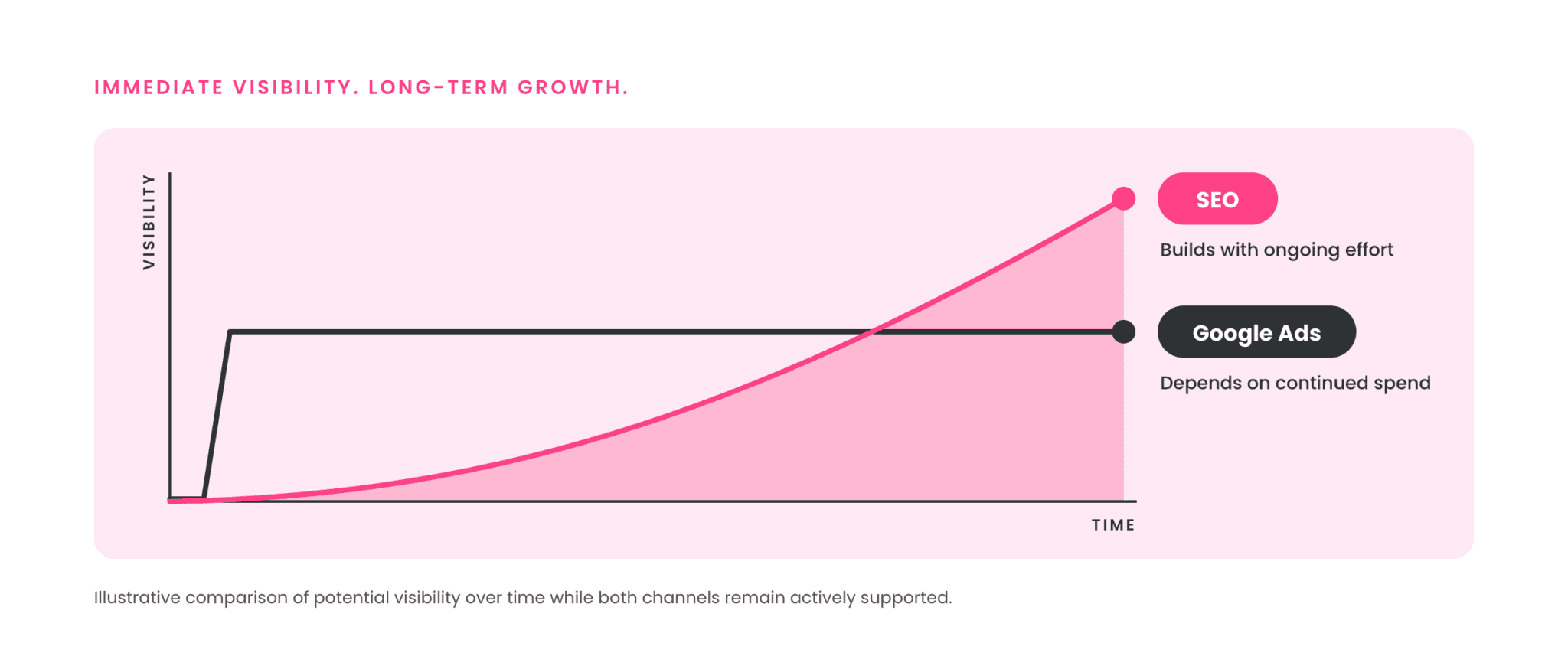
Google Ads puts you in front of those searches straight away, giving you much more control over where, when and what you appear for – but you pay for each click, and the moment you stop paying, the visibility disappears.
Key takeaways:
- SEO typically takes longer to build, but can deliver value long after the initial work has been done.
- Google Ads delivers fast, measurable visibility but stops the moment you stop paying
- For most professional services firms, the strongest and most competitive strategy isn’t choosing between the two. Its knowing how and when to use both.

SEO for Professional Services Firms: How Does It Work?
SEO is about improving your website’s visibility in organic search results.
For a professional services firm, that can mean ranking for terms like “corporate tax advisor London” or “commercial litigation solicitor” or a question related to the service you provide, without paying Google for every time they click.
But ranking in professional services isn’t simply a case of putting the right keyword on a page a few times. Trust matters.
Google looks for signals of Experience, Expertise, Authoritativeness, and Trust (E-E-A-T)
when deciding which professional services content deserves to rank. This makes demonstrating genuine expertise particularly important. Real people, strong partner profiles, first-hand experience, useful case studies, and content that actually says something are far more valuable than another generic 1000-word blog.
We go into this in more detail in our article on E-E-A-T for law firms, consultants and financial services brands .
Good SEO brings a few things together: a technically healthy website, genuinely useful content, and enough authority around your brand to give search engines and prospective clients confidence in you.
Google Ads for Professional Services Firms: How Does It Work?
Google Ads gives you the shortcut to the top of the search results.
Rather than waiting for organic rankings to build, you can pay to appear for the searches that matter most to your business. That makes PPC particularly useful if you’re launching a new product, entering a new market, pushing a particular service, or simply need to fill a pipeline quicker.
The trade-off is cost per click. Legal, financial and other high-value professional services searches can be among the most expensive in the UK due to high competition and high client lifetime value. This means throwing more budget at Google isn’t enough; campaigns need tight targeting, strong ad copy, and, crucially, people need somewhere good to land once they click.
Otherwise your paying premium prices sto send potential clients to a page that doesn’t convince them to do anything.
Google is continuing to change how ads are presented within results, which affects visibility and cost, something we covered in our piece on the Google Search Ads update and what it means for marketers.
Building a Channel Strategy That Works
- Work out where your visible now: Do a little research to understand your starting point. A few quick searches will show you where there are gains to be made.
- Match the Channel to the Search: Different searches need a different approach; knowing the difference helps you spend budget more efficiently.
- Use Google Ads for Speed and SEO for the Longer Game. This approach allows you to capture current searches whilst building your organic presence in the background.
- Give Your Important Searches Room to Breathe. Trying to get one generic page ranking for multiple terms is asking a lot of one URL. This goes for both your Google Ads and SEO; well-structured and specific pages are worth the time investment.
- Measure Enquiries, Not Just Clicks. Ten high-quality leads are worth far more that 10,00 clicks that do nothing on site. Your reporting should go beyond traffic & impressions.
- Let the Channels Learn From Each Other: Whilst they require different approaches, they don’t work in silo. As organic visibility strengthens, you can make more informed decisions about where to put paid budget.
Where We Often See Things Go Wrong
There are a few repeat offenders.
Bidding on broad, expensive keywords without keeping a close eye on the searches they trigger. Publishing pages because “SEO says we need content” rather than because they’re genuinely useful. Sending expensive paid traffic to generic service pages. Or pulling the plug on SEO after three months because the leads haven’t suddenly flooded in.
Neither channel is magic.
Google Ads needs enough data, budget and optimisation to work effectively. SEO needs time to build authority and momentum.
Before investing heavily in either, make sure the foundations are there. Is conversion tracking working properly? Can you tell which activity generates enquiries? Are your service pages actually convincing? Does your website demonstrate real expertise? Is your Google Business Profile doing its job?
Getting those basics right makes every pound you spend afterwards work harder.
Why Work With a Professional Services Marketing Agency?
Professional services marketing comes with its own set of challenges.
You’re often selling something complex, valuable and difficult to compare. The buying journey can be long, several decision-makers may be involved and the most commercially important enquiry isn’t always the easiest one to generate.
A good professional services marketing agency should understand that more traffic isn’t the end goal. The aim is to generate the right visibility, for the right services, among the organisations and people your firm actually wants to work with.
That means bringing SEO, paid media, content and conversion tracking together around the same commercial priorities, rather than treating each channel as a separate monthly task list.
It also means being prepared to challenge the brief. Sometimes the best opportunity is a new paid campaign. Sometimes it’s improving the service page you’re already sending people to. Sometimes it’s sorting out the tracking before another pound goes into media.
The channel recommendation should follow the business problem, not the other way around.
So, Should You Invest in SEO or Google Ads?
It depends on what you need to achieve.
If you need visibility and pipeline quickly, Google Ads is likely to play a bigger role.
If you’re trying to reduce your reliance on paid acquisition and build long-term visibility around your expertise, SEO needs to be part of the picture.
For most established professional services firms, though, we wouldn’t treat them as competing channels.
Google Ads gives you speed, control and data. SEO builds authority, visibility and longer-term value.
The interesting bit is deciding how much you invest in each, and when.
That’s where a wider digital strategy becomes important. Our digital marketing consultancy work helps businesses make those decisions based on where they are now and where they’re trying to get to, rather than simply recommending another channel.
If you already know where the opportunity lies, our SEO and PPC teams can tackle either channel independently or together.
Frequently Asked Questions
Is SEO or Google Ads better for a new law firm?
If you’re starting with very little organic visibility, Google Ads can get you in front of prospective clients much faster. But we’d usually recommend building SEO alongside it, so paid media doesn’t remain your only route to search visibility.
How much should a professional services firm budget for Google Ads?
There isn’t a useful one-size-fits-all figure. Your location, services, competition and average client value all matter. In competitive legal and financial markets, though, you’ll generally need a meaningful four-figure monthly media budget to gather enough data and give campaigns room to work.
How long does SEO take to work for an accountancy firm?
You can start seeing movement within the first few months, but SEO is a longer-term investment. Generally, we’d expect meaningful progress within three to six months, with the value continuing to build over 12 months and beyond.
Can I run SEO and Google Ads at the same time?
Absolutely, and there are some big advantages to doing so. Paid search can tell you relatively quickly which keywords and services generate good enquiries, while SEO can build longer-term visibility around those opportunities.
What Should I Look for in a Professional Services Marketing Agency?
Look for an agency that understands how considered, trust-led services are bought, and can connect its marketing activity to genuine enquiries and revenue. Your agency should be able to explain why it is recommending a particular channel, how performance will be measured and what it will do with the data once campaigns are running. You should be getting a joined-up strategy, not isolated reports from teams that never speak to each other.
SEO or Google Ads? Probably Both. Just Not Necessarily Equally.
SEO and Google Ads solve different problems.
Google Ads can put you in the room quickly. SEO helps make sure you’re still in the room when the ad budget isn’t doing the talking.
The right balance comes down to your current visibility, growth priorities, timescales and budget, not a blanket rule about which channel is “better”.
If you’re looking for a professional services marketing agency to help you work out where your next chunk of budget will have the biggest impact, get in touch.
We’ll help you decide what’s worth doing, what can wait and where your budget has the best chance of turning into actual business.
Or, take a look through our case studies to see how we’ve helped professional services firms turn visibility into new business.